Entree: United States – American goulash
Food safety reminder: Follow safe food-handling practices and use a food thermometer to verify safe internal cooking temperatures.
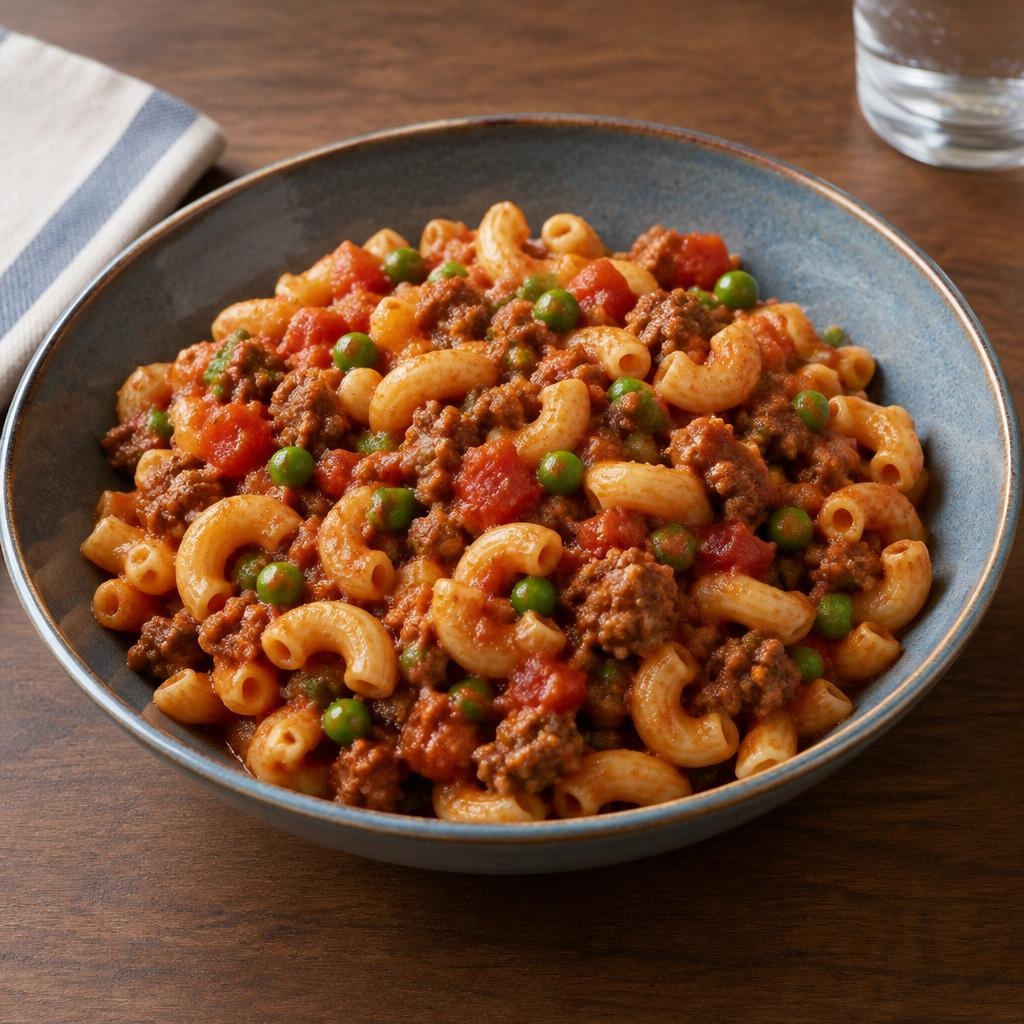
Serving Size: 4
Ingredients
- 1 lb (454 g) ground beef (hamburger), raw
- 8 oz (227 g) elbow macaroni, dry
- 1 can (14.5 oz (411 g)) canned tomatoes, undrained
- 2 tbsp (30 ml) tomato paste
- 1 cup (240 ml) water (for sauce)
- 1 cup (150 g) frozen peas (optional)
- 4 qts (15 7/8 cups (3.8 L)) water (for boiling pasta)
- salt, to taste
- black pepper, to taste
Instructions
U.S. measurements first, metric equivalents in parentheses. Conversions are approximate.
1. Bring 4 qts (15 7/8 cups (3.8 L)) water to a rolling boil in a 6- to 8-quart (7.68 L) pot over high heat; add salt to taste, then add 8 oz (227 g) elbow macaroni and cook, stirring occasionally, until al dente (about 8–10 minutes). Reserve 1/2 cup (120 ml) of the pasta cooking water, then drain the pasta and set aside.
2. While the pasta cooks, heat a 12-inch (30 cm) heavy skillet over medium-high heat. Add 1 lb (454 g) ground beef (hamburger), break into 1/2–1 inch (1.27 to 2.54 cm) pieces with a spatula, and cook, stirring and turning, until no pink remains and the beef is browned and beginning to render fat, about 7–9 minutes. Use an instant-read thermometer to confirm the ground beef reaches 160 F (71 C).
3. If there is an excessive pool of fat in the pan, carefully tilt the pan and spoon off and discard most of the fat; leave a thin coating to carry flavor. Reduce heat to medium, add 1 can (14.5 oz (411 g)) canned tomatoes (undrained) and 2 tbsp (30 ml) tomato paste, stir to combine, and add 1 cup (240 ml) water (or use reserved pasta water to adjust consistency).
4. Bring the sauce to a gentle simmer, reduce heat to low, and simmer uncovered, stirring occasionally, 10–15 minutes until the sauce thickens slightly and flavors meld. Season with salt and black pepper to taste. If using 1 cup (150 g) frozen peas, stir them in during the last 3 minutes of simmering so they heat through.
5. Add the drained macaroni to the skillet and toss to coat; if the mixture seems dry, add up to the reserved 1/2 cup (120 ml) pasta water a few tablespoons at a time until desired sauciness is reached. Adjust seasoning and serve hot.
Show original instructions
1. Bring 4 qts (3.8 L) water to a rolling boil in a 6- to 8-quart pot over high heat; add salt to taste, then add 8 oz (227 g) elbow macaroni and cook, stirring occasionally, until al dente (about 8–10 minutes). Reserve 1/2 cup (120 ml) of the pasta cooking water, then drain the pasta and set aside.
2. While the pasta cooks, heat a 12-inch heavy skillet over medium-high heat. Add 1 lb (454 g) ground beef (hamburger), break into 1/2–1 inch pieces with a spatula, and cook, stirring and turning, until no pink remains and the beef is browned and beginning to render fat, about 7–9 minutes. Use an instant-read thermometer to confirm the ground beef reaches 160 F (71 C).
3. If there is an excessive pool of fat in the pan, carefully tilt the pan and spoon off and discard most of the fat; leave a thin coating to carry flavor. Reduce heat to medium, add 1 can (14.5 oz / 411 g) canned tomatoes (undrained) and 2 tbsp (30 ml) tomato paste, stir to combine, and add 1 cup (240 ml) water (or use reserved pasta water to adjust consistency).
4. Bring the sauce to a gentle simmer, reduce heat to low, and simmer uncovered, stirring occasionally, 10–15 minutes until the sauce thickens slightly and flavors meld. Season with salt and black pepper to taste. If using 1 cup (150 g) frozen peas, stir them in during the last 3 minutes of simmering so they heat through.
5. Add the drained macaroni to the skillet and toss to coat; if the mixture seems dry, add up to the reserved 1/2 cup (120 ml) pasta water a few tablespoons at a time until desired sauciness is reached. Adjust seasoning and serve hot.
Estimated Nutritional Information*
Per serving | Servings: 4
Calories: 506 kcal
Carbohydrates: 52.6 g
Protein: 31.6 g
Fat: 18.3 g
Saturated fat: 6.7 g
Trans fat: 1 g
Cholesterol: 77 mg
Fiber: 5.8 g
Sugar: 7 g
Sodium: 282 mg
Potassium: 796 mg
Calcium: 104 mg
Iron: 5.64 mg
Vitamin A: 70 µg RAE
Vitamin C: 21.4 mg
Vitamin D: 0.1 µg
Generated: 2026-11-09T06:18:05+00:00
*Values are estimates based on USDA data and mathematical calculations. Actual values may vary. Where data are unavailable, those contributions are excluded. Calories, Carbohydrates, Protein, Fat, Saturated fat, Trans fat, Cholesterol, Fiber, Sugar, Sodium, Potassium, Calcium, Iron, Vitamin A, Vitamin C and Vitamin D are known subtotals. Missing contributions are unknown, not zero.