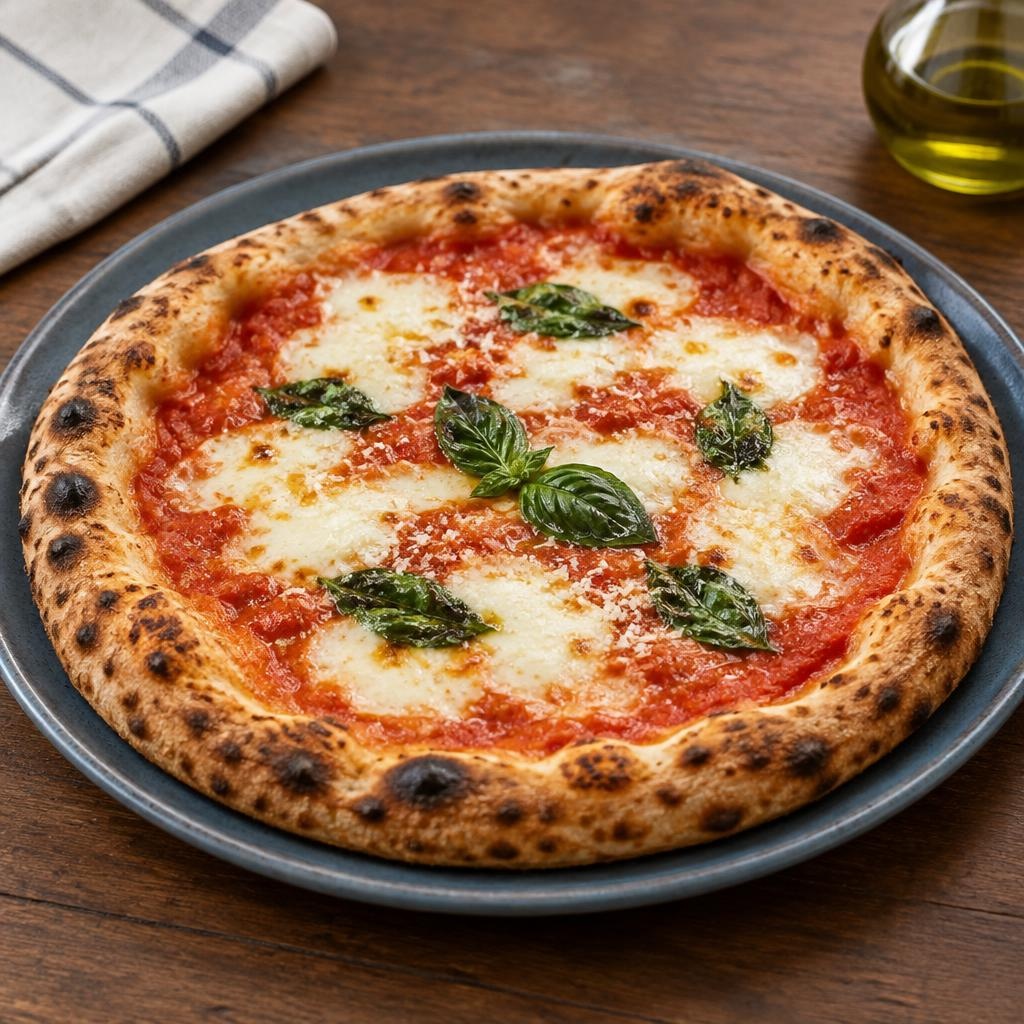
Entree: Italy – Campania – Pizza Margherita a lunga lievitazione (Margherita pizza with long-fermented dough)
Food safety reminder: Follow safe food-handling practices and use a food thermometer to verify safe internal cooking temperatures.
Created by Kitchen2MyTable
Inspired by “Best Homemade Pizza Recipe With 72-Hour Dough” from www.vincenzosplate.com
Serving Size: 6
Approximate Time
Prep
30 min
Cook
6 min
Additional
51 hrs 30 min
Total
51 hrs 36 min
Ingredients
- 35 oz (1 kg) "00" pizza flour (Tipo 00)
- 2 3/4 cups (650 ml) cold water
- 2 tsp (8.4 g) active dry yeast
- 5 tsp (30 g) fine sea salt
- 2 tbsp (30 ml) extra virgin olive oil (for dough)
- 1 cup (160 g) semolina flour, plus extra for dusting
- 28 oz (800 g) canned whole peeled San Marzano tomatoes
- salt, to taste
- 8 oz (225 g) fresh Fior di latte or buffalo mozzarella, torn
- 1/3 cup (35 g) Pecorino Romano, grated
- A handful fresh basil leaves
- extra virgin olive oil, to taste (for finishing)
Instructions
1. Day 1 — mix: In a bowl dissolve 2 tsp (8.4 g) yeast in 2 3/4 cups (650 ml) cold water. In a large bowl loosen the flour and make a shallow well; pour in the yeast water and mix with one hand until a rough, shaggy dough forms (about 8–10 minutes).
2. Knead and salt: Turn dough onto a lightly floured surface and knead 8–10 minutes until it begins to smooth; add 5 tsp (30 g) fine sea salt partway through kneading so it incorporates evenly. Finish by kneading in 2 tbsp (30 ml) extra virgin olive oil until absorbed.
3. Bulk development and folds: Place dough in a lightly oiled bowl, cover, and rest 30 minutes. Perform four sets of gentle stretch-and-folds at 30-minute intervals (lift a dough edge and fold over toward center, rotate 90° and repeat) to develop strength without overworking.
4. Cold fermentation: After the last fold, oil the bowl, cover airtight with plastic wrap, and refrigerate for 48–72 hours. This long, slow cold fermentation develops flavor and makes the dough easier to stretch.
5. Day 3 — warm and portion: Remove dough from the fridge about 2 hours before shaping to take the chill off. Turn the dough onto a bench, divide with a bench scraper into six portions of approximately 9.5 oz (270 g) each, and shape each into a smooth, tight ball.
6. Final proof: Place dough balls seam-side down in lightly oiled containers or a tray spaced apart, dust tops lightly with semolina, cover, and proof at room temperature for about 3–4 hours until slightly risen and soft.
7. Sauce: Meanwhile, crush the 28 oz (800 g) canned whole peeled San Marzano tomatoes by hand or a food mill for a rustic sauce. Season with salt, to taste; do not cook the sauce — keep it bright and fresh.
8. Oven and tools: Place a pizza stone or steel on the top rack and preheat the oven to its maximum for at least 45–60 minutes (ideally 550°F / 288°C or as hot as your oven allows). Have a well-dusted pizza peel ready with semolina.
9. Stretching: On a semolina-dusted surface or over an inverted bowl, gently press and stretch each dough ball from the center outward to a roughly 10–12 inch (25–30 cm) disk, leaving a slightly thicker rim for the cornicione. Transfer the disk to the semolina-dusted peel, rough side up.
10. Topping: Flip the stretched dough so the rough side is down. Spoon 2–3 oz (60–90 g) of the crushed tomato onto each base and spread lightly with the back of the spoon, leaving the rim bare. Sprinkle about 1 tbsp (8–9 g) Pecorino Romano over the sauce, place 3–6 basil leaves, then distribute torn mozzarella evenly. Finish with a light drizzle of extra virgin olive oil, to taste.
11. Bake: Slide the pizza onto the preheated stone/steel and bake at maximum heat for about 5–7 minutes, rotating once halfway, until the crust is blistered and leopard-spotted and the cheese is melted and slightly golden. Adjust time for your oven’s top heat and temperature.
12. Finish and serve: When baked, remove pizza, add a few fresh basil leaves, a final light drizzle of extra virgin olive oil, and a small sprinkle of Pecorino if desired. Slice and serve immediately.
Estimated Nutritional Information*
Per serving | Servings: 6
Calories: 903 kcal
Carbohydrates: 152.9 g
Protein: 32.4 g
Fat: 16.7 g
Saturated fat: 7.2 g
Cholesterol: 36 mg
Fiber: 8.5 g
Sodium: 2366 mg
Potassium: 533 mg
Calcium: 332 mg
Iron: 9.14 mg
Vitamin A: 102 µg RAE
Vitamin C: 17 mg
Vitamin D: 0.2 µg
Generated: 2026-11-05T20:05:12+00:00
*Values are estimates based on USDA data and mathematical calculations. Actual values may vary. Where data are unavailable, those contributions are excluded.