Entree: France – Cailles rôties aux abricots (Roast quail with apricots)
Food safety reminder: Follow safe food-handling practices and use a food thermometer to verify safe internal cooking temperatures.
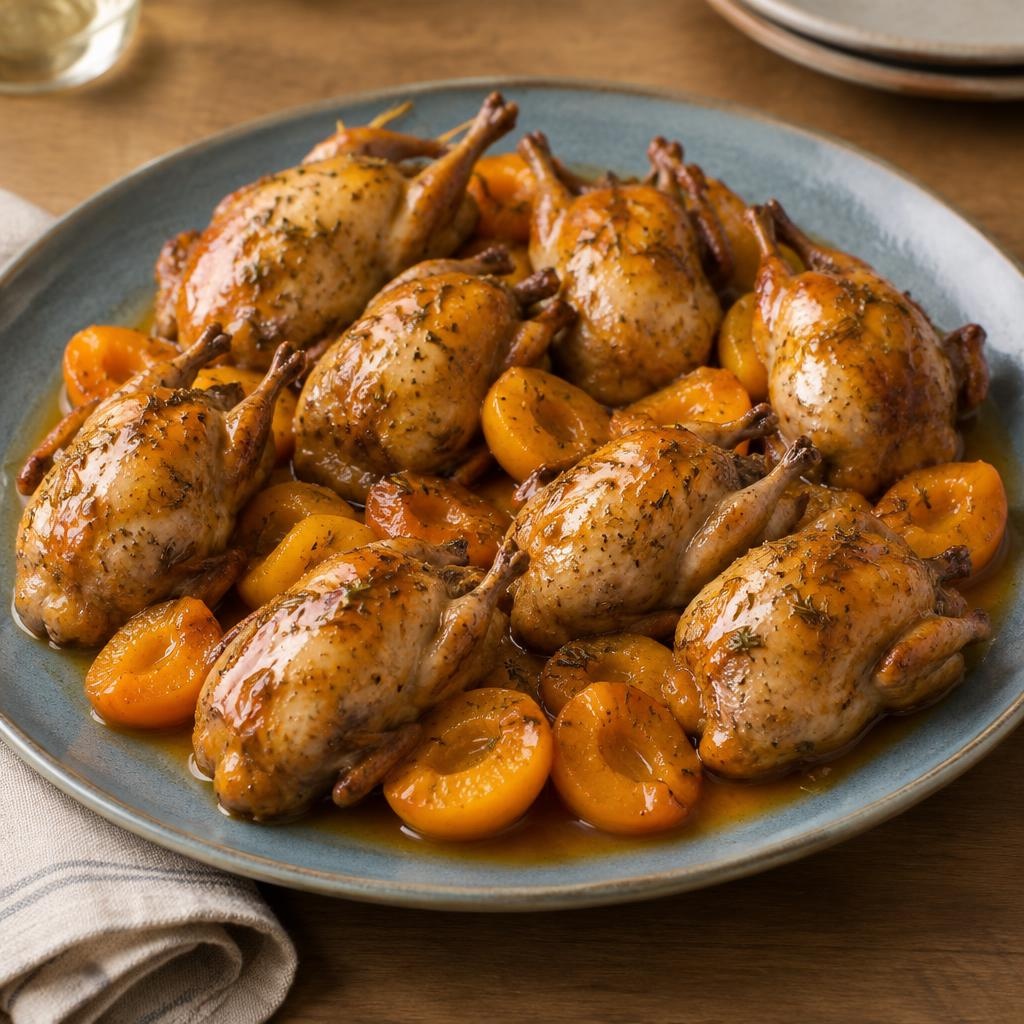
Serving Size: 4
Approximate Time
Prep
20 min
Cook
20 min
Additional
5 min
Total
45 min
Ingredients
- 8 whole quail, approx. 5 oz (140 g) each
- 12 fresh apricots, halved and pitted, approx. 1 lb (450 g) total
- 1/3 cup (80 ml) water
- 2 tbsp (30 ml) ordinary cooking oil
- salt, to taste
- black pepper, to taste
- dried thyme, to taste
- dried rosemary, to taste
Instructions
1. Preheat the oven to 400°F (200°C). Pat the quail dry, then season inside and out with salt and black pepper and a light sprinkle of dried thyme and dried rosemary.
2. Make the apricot glaze: place the halved apricots, 1/3 cup (80 ml) water, a salt, to taste, a little black pepper, and a scattering of dried thyme and dried rosemary in a small saucepan. Bring to a gentle simmer over medium-low heat and cook, stirring occasionally, until the apricots are very soft and the liquid is slightly reduced, about 10–12 minutes.
3. Purée the softened apricots and cooking liquid until smooth (use a blender, immersion blender, or mash through a sieve). Return the purée to the saucepan and simmer over low heat, stirring, until it thickens to a glaze consistency that coats the back of a spoon, about 6–8 minutes more. Keep warm.
4. Heat 2 tbsp (30 ml) ordinary cooking oil in an ovenproof skillet over medium-high heat until shimmering. Add the quail, breast side down, and brown on all sides, about 2–3 minutes per side, so the skin is golden.
5. Brush each quail generously with the apricot glaze, then transfer the skillet to the preheated oven. Roast until the quail are cooked through and juices run clear, about 10–12 minutes (internal temperature around 165°F / 74°C), brushing once more with glaze halfway through roasting.
6. Remove the skillet from the oven and transfer the quail to a plate to rest for 5 minutes. Spoon any remaining glaze from the pan over the quail before serving.
Estimated Nutritional Information*
Per serving | Servings: 4
Calories: 598 kcal
Carbohydrates: 12.5 g
Protein: 51 g
Fat: 37.6 g
Saturated fat: 9.6 g
Cholesterol: 192 mg
Fiber: 2.3 g
Sodium: 135 mg
Potassium: 836 mg
Calcium: 48 mg
Iron: 10.45 mg
Vitamin A: 292 µg RAE
Vitamin C: 26.6 mg
Generated: 2026-11-05T20:05:10+00:00
*Values are estimates based on USDA data and mathematical calculations. Actual values may vary. Where data are unavailable, those contributions are excluded.