Entree: Canada – Pacific Canada (British Columbia) – Okanagan Valley Roast Duck
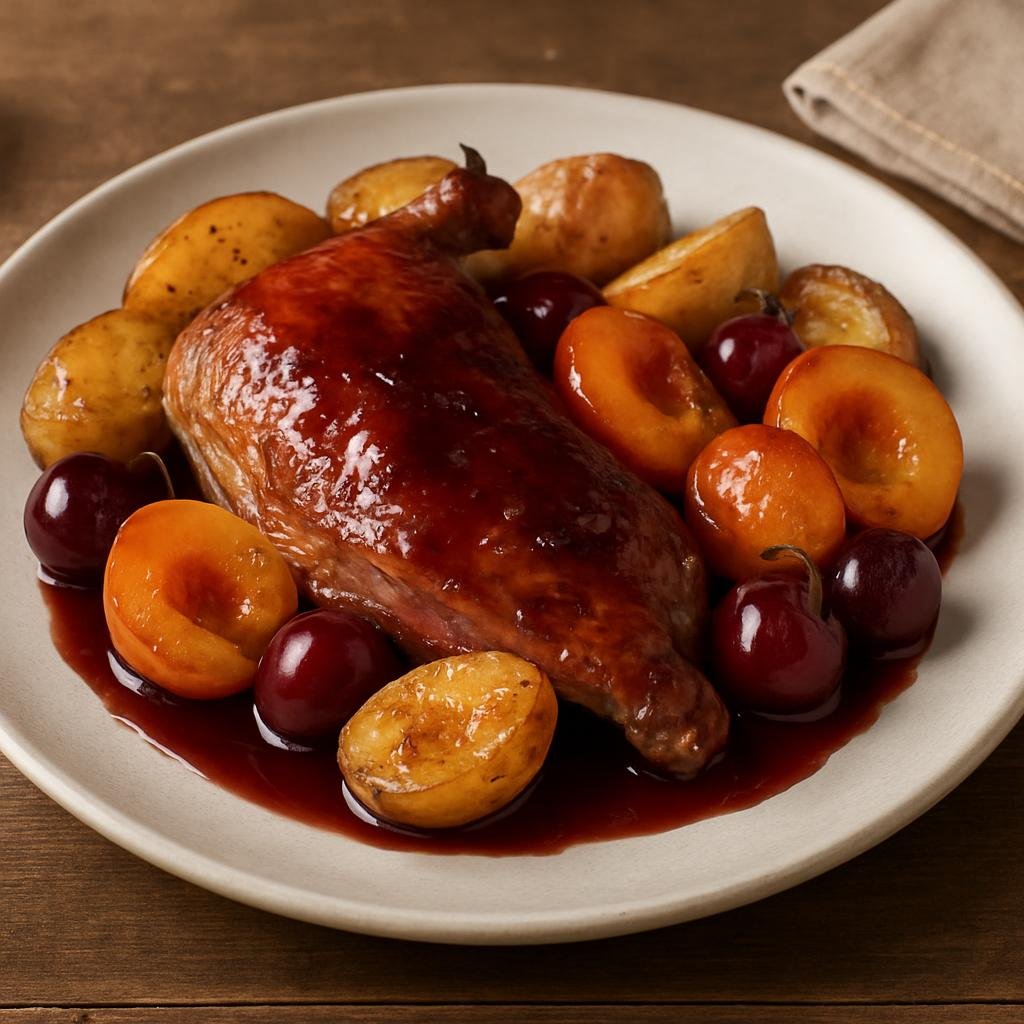
Serving Size: 6
Approximate Time
Prep
40 min
Cook
2 hrs 5 min
Additional
20 min
Total
3 hrs 5 min
Ingredients
- 2 whole ducks, approx. 3.5 lb (1.6 kg) each, giblets removed
- 1 tbsp (15 ml) kosher salt, plus more for seasoning
- 1 tsp (5 ml) freshly ground black pepper
- 2 tsp (10 ml) dried thyme
- 4 sprigs fresh rosemary
- 2 medium onions, quartered — about 10 oz (280 g)
- 1 head garlic, halved crosswise
- 2 cups (300 g) mixed Okanagan stone fruit, halved (apricots and peaches) and pitted; if unavailable, use 1 cup apricots + 1 cup peaches
- 1/2 cup (75 g) Okanagan cherries, pitted (optional)
- 1 cup (240 ml) Okanagan Pinot Noir (or local red wine)
- 1/2 cup (160 g) apricot jam (or apricot preserves)
- 3 tbsp (45 ml) honey
- 2 tbsp (30 ml) balsamic vinegar
- 1 tbsp (15 ml) Dijon mustard
- 2 shallots, finely chopped — about 2 oz (60 g)
- 4 tbsp (60 g) unsalted butter
- 1/2 cup (120 ml) reserved rendered duck fat (from roasting) or clarified butter if needed
- 1.5 lb (680 g) Yukon gold potatoes, halved
- 1 lb (450 g) Brussels sprouts, trimmed and halved
- 2 tbsp (30 ml) olive oil
- Salt and pepper to taste
- 1/4 cup (15 g) chopped flat-leaf parsley for garnish
- Optional: 1 cup (240 ml) cooked wild rice or rice pilaf per side if you prefer extra starch
Instructions
Short Description:
Whole roasted duck glazed with an Okanagan wine and stone-fruit glaze, served with duck-fat roasted Yukon gold potatoes and caramelized Brussels sprouts — a complete main course showcasing Okanagan fruits and wine.

Regional Notes:
This British Columbia Okanagan variation uses local stone fruit (apricots/peaches/cherries) and a reduction of Okanagan Pinot Noir (or local red) as the glaze base, and leverages rendered duck fat to roast potatoes — reflecting the Okanagan Valley's fruit and wine production. It differs from generic roast duck by highlighting fresh regional fruit and a wine-fruit glaze rather than purely citrus or Asian-style glazes.

1. Preheat the oven to 425°F (220°C). Line a large roasting pan with a rack.
2. Pat the ducks dry inside and out with paper towels. Trim excess fat from neck area. Using a sharp knife, score the skin in a diamond pattern without cutting into the meat. Season inside and out with 1 tbsp (15 ml) kosher salt, 1 tsp (5 ml) black pepper, and 1 tsp (5 ml) dried thyme.
3. Stuff each cavity with 1/2 the quartered onion, 1 head garlic half, 2 sprigs rosemary, and about 1 cup (150 g) of the halved stone fruit (save the rest for the glaze and roasting pan). Tie the legs with kitchen twine and tuck the wings under.
4. Place ducks breast-side up on the rack in the roasting pan. Roast at 425°F (220°C) for 25 minutes to begin crisping the skin and rendering fat.
5. Reduce oven temperature to 350°F (175°C). Pour off and reserve roughly 1/2 cup (120 ml) rendered fat from the bottom of the pan into a heatproof container (you may need to skim fat twice during roasting). Continue roasting the ducks about 65–75 minutes more (total roasting time about 90–100 minutes) until an instant-read thermometer inserted into the thickest part of the thigh registers 165–170°F (74–77°C). Baste with pan juices once or twice during roasting.
6. While ducks roast, prepare the glaze: In a medium saucepan over medium heat, melt 2 tbsp (30 g) butter and sweat the shallots until translucent, about 3 minutes. Add the remaining 1 cup (240 ml) Pinot Noir and bring to a simmer to reduce by about half, 6–8 minutes.
7. Stir in the reserved stone fruit (about 1 cup/150 g), apricot jam, 3 tbsp (45 ml) honey, 2 tbsp (30 ml) balsamic vinegar, and 1 tbsp (15 ml) Dijon mustard. Add 2 sprigs fresh thyme (or 1 tsp dried). Simmer gently until the mixture thickens to a syrupy glaze, about 8–10 minutes. Finish by whisking in 2 tbsp (30 g) cold butter, then taste and adjust seasoning. Strain if you prefer a smooth glaze.
8. Meanwhile, toss Yukon gold potatoes with 2 tbsp (30 ml) reserved duck fat (or olive oil if needed), salt, and pepper. Spread on a baking sheet cut-side down. Roast in the oven at 400°F (200°C) for 30–35 minutes until golden and crisp.
9. Toss Brussels sprouts with 1 tbsp (15 ml) reserved duck fat (or 1 tbsp olive oil), salt, and pepper. Roast on a separate sheet in the oven at 400°F (200°C) for 20–25 minutes until caramelized and tender, shaking pan halfway through. For extra flavor, add halved stone fruit to the sprouts pan for the last 8–10 minutes to caramelize.
10. When the duck reaches 165–170°F (74–77°C), remove from oven and let rest on a cutting board, loosely tented with foil, for 15–20 minutes. During the last 5 minutes of resting, brush the duck all over with the warm wine-fruit glaze and return to the oven at 450°F (230°C) for 5 minutes to set the glaze and crisp the skin.
11. Carve the duck into breasts, legs, and wings. Arrange on a platter with roasted potatoes and Brussels sprouts. Spoon remaining glaze over the carved meat, garnish with chopped parsley, and serve with extra glaze on the side. If using, spoon wild rice alongside for additional starch.
12. Leftover duck fat can be strained and refrigerated for future roasting; saved glaze keeps refrigerated up to 3 days.
Nutrition Information
To get nutritional information, press the Get Nutrition Info button below.