Dessert: Mexico – Bajio Mexico — San Luis Potosí – Ate de Membrillo (Quince Paste)
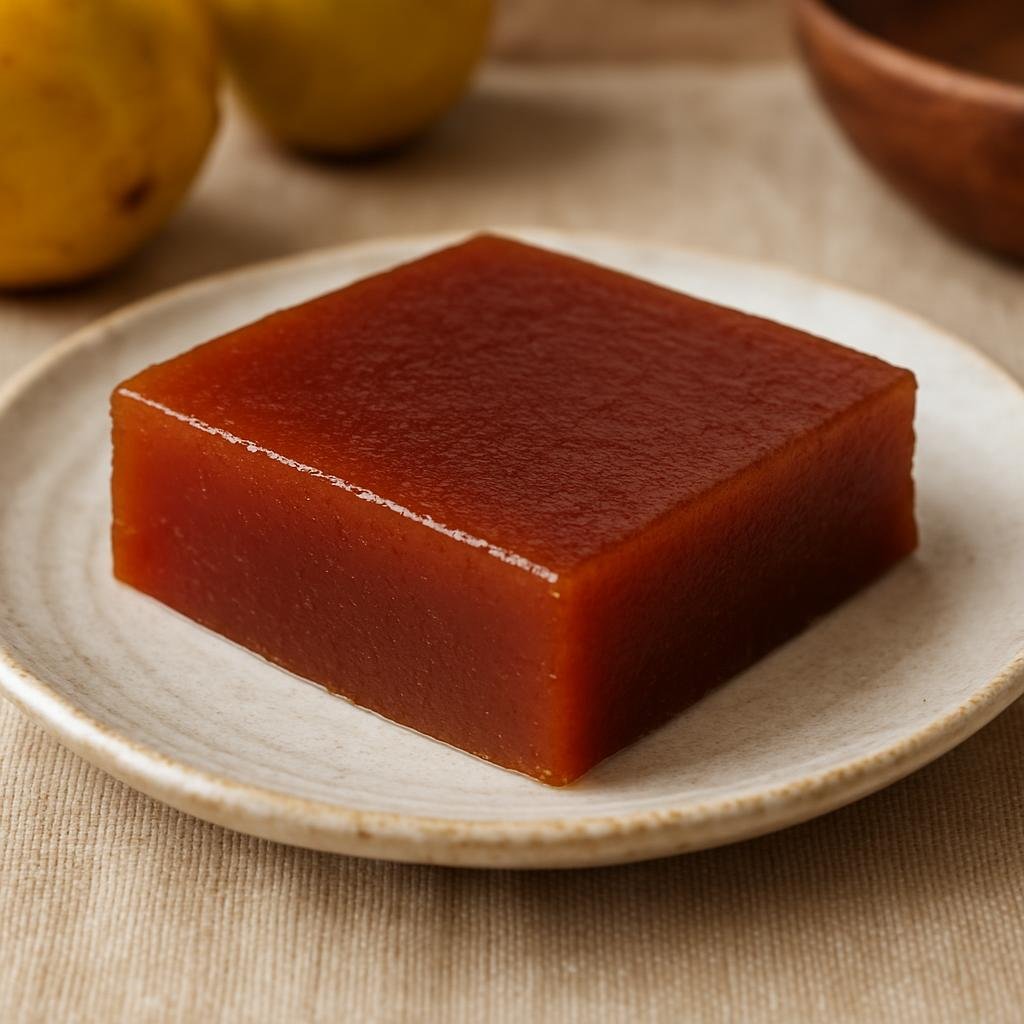
Serving Size: 12
Approximate Time
Prep
30 min
Cook
1 hr 50 min
Additional
12 hrs
Total
14 hrs
Ingredients
- 4 lb (1.8 kg) quince fruit (about 6–8 medium quinces)
- 3 cups (720 ml) water, plus extra as needed for cooking
- 4 cups (800 g) granulated sugar — or sugar equal to the weight of the strained quince pulp (see instructions)
- 2 tbsp (30 ml) fresh lemon juice
- 1 small cinnamon stick (optional)
- Pinch fine salt
- 1 tbsp (15 g) unsalted butter or neutral oil (for greasing mold)
Instructions
Short Description:
A dense, glossy quince paste made by cooking ripe quince with sugar until it reaches a smooth, firm jelly; traditionally sliced and served with fresh cheese or on its own as a sweet finish.

Regional Notes:
This San Luis Potosí version emphasizes a very smooth texture and deep, rich quince flavor, achieved by sieving the cooked quince pulp and slow, patient reduction. Local quince varieties from the Bajio contribute an intense aroma and color distinct from other regional ates.

1. Rinse quinces well to remove fuzz. Peel, quarter, and core the quinces, removing seeds and tough cores. Roughly chop the flesh into 1-inch pieces.
2. Place chopped quince in a large heavy-bottomed pot with 3 cups (720 ml) water and the cinnamon stick (if using). Bring to a simmer over medium heat, then reduce heat to low, cover, and cook until quinces are completely soft and easily mashed, about 25–35 minutes. Add small splashes of water if the pot runs dry.
3. Remove from heat. Discard the cinnamon stick. Working in batches if necessary, puree the cooked quince with an immersion blender or in a food processor until very smooth.
4. Pass the quince puree through a fine-mesh sieve or food mill into a clean bowl, pressing with a spatula or spoon to extract as much smooth pulp as possible — this sieving is key to the San Luis Potosí smooth texture. Weigh the strained pulp or measure volume. (If you do not have a scale, the processed yield will be roughly 4 cups / 900–1000 g.)
5. Measure out an equal weight of granulated sugar to the strained pulp and return the pulp and measured sugar to the cleaned heavy-bottomed pot. If you did not weigh the pulp, use about 4 cups (800 g) sugar for approximately 4 cups strained pulp as a guideline. Add the lemon juice and a pinch of salt.
6. Cook the quince-sugar mixture over low to medium-low heat, stirring constantly at first to dissolve the sugar, then more frequently as it thickens to prevent scorching. Skim any foam that rises. Continue reducing until the mixture darkens to deep rose-amber and thickly coats the spoon, about 45–75 minutes. The paste will pull away from the sides of the pot and form a mass; a reliable target is 220–225°F (105–107°C) on a candy thermometer, but visual cues (thick, almost paste-like body that doesn't run easily) are sufficient.
7. When the paste is very thick and glossy, remove from heat and stir for a minute to smooth any graininess. Quickly scrape into a buttered 8 x 8-inch (20 x 20 cm) or similarly sized shallow mold lined with parchment and buttered. Smooth the top with a spatula.
8. Let cool at room temperature until firm, then cover and refrigerate for at least 12 hours (overnight) to fully set and develop flavor. The paste will firm up considerably as it chills.
9. Unmold the set ate onto a cutting board. Optionally dust a little granulated sugar on the surface to prevent sticking, then cut into slices or cubes. Serve with fresh cheese (such as panela or queso fresco), on crackers, or simply as a sweet slice.
10. Store airtight in the refrigerator for up to 2 weeks or wrap tightly and freeze for longer storage.
Nutrition Information
To get nutritional information, press the Get Nutrition Info button below.